

Reflections from an experienced family lawyer and mediator at Creative Family Law Solutions
One of the greatest challenges for family lawyers, mediators, counsellors, and support professionals is understanding the behaviour of a person who uses family violence. Victim-survivors often ask:
- “Why is he doing this?”
- “Does he know what he is doing?”
- “Can he change?”
- “Will he ever take responsibility?”
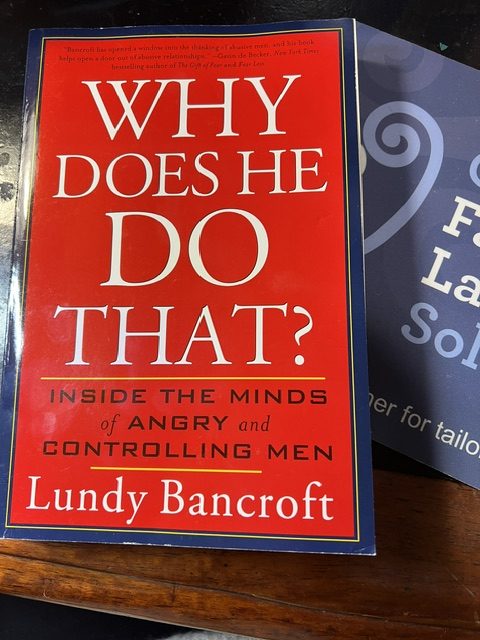
These questions sit at the heart of Lundy Bancroft’s influential book, Why Does He Do That?.
Drawing on decades of experience working directly with men who used violence and coercive control in their intimate relationships, Bancroft challenges many of the common assumptions that society makes about perpetrators of family violence. His work provides valuable insights for family lawyers and mediators seeking to understand the dynamics affecting families while maintaining a clear focus on safety, accountability, and the best interests of children.
The Central Insight: Family Violence is About Power, Not Anger
One of Bancroft’s most important observations is that abusive behaviour is rarely caused by a loss of control.
Many perpetrators describe themselves as having “anger problems.” Family members and friends may accept this explanation, believing that the violence occurs because the person simply becomes overwhelmed by emotion.
Bancroft argues that this explanation is often misleading.
The problem is not that the perpetrator loses control. The problem is that they use control.
The abusive behaviour frequently serves a purpose:
- maintaining power within the relationship;
- avoiding accountability;
- obtaining compliance;
- silencing disagreement;
- protecting entitlement; or
- preserving a preferred version of reality.
This distinction is critically important for family lawyers and mediators. If family violence is understood merely as poor anger management, interventions may focus on emotional regulation alone. If the behaviour is understood as a pattern of coercion and control, the response must be much broader.
Understanding Entitlement
A recurring theme throughout Bancroft’s work is the concept of entitlement.
Many perpetrators hold deeply embedded beliefs that:
- their needs should come first;
- they should have greater authority within the relationship;
- they are entitled to obedience, loyalty, or emotional caretaking;
- criticism of them is unfair or disrespectful; and
- their partner is responsible for managing their feelings.
These beliefs may not always be consciously expressed. However, they often underpin patterns of coercive and controlling behaviour.
This understanding aligns closely with contemporary descriptions of coercive control and family violence recognised within Australian family law.
When viewed through this lens, many behaviours that might appear isolated or insignificant begin to form a coherent pattern:
- monitoring communications;
- controlling finances;
- restricting social connections;
- undermining confidence;
- intimidating through anger;
- manipulating children; and
- demanding constant emotional attention.
The issue is not a single incident. The issue is the ongoing exercise of power.
Why Victims Often Struggle to Explain What Is Happening
One of the most valuable insights for practitioners is Bancroft’s explanation of why victim-survivors often struggle to articulate their experiences.
Many clients arrive at a lawyer’s office saying:
“Nothing terrible happened.”
Yet they describe years of fear, confusion, self-doubt, and emotional exhaustion.
This occurs because coercive control often operates through hundreds of small acts rather than a single dramatic event.
A survivor may not initially identify:
- emotional abuse;
- intimidation;
- gaslighting;
- financial abuse;
- social isolation; or
- coercive control
as family violence.
Instead, they describe feeling as though they are “walking on eggshells.”
From a legal and mediation perspective, understanding these dynamics helps practitioners ask better questions and recognise risk that may not be immediately apparent.
The Importance of Accountability
Perhaps Bancroft’s strongest message is that meaningful change is impossible without accountability.
Many perpetrators:
- minimise their conduct;
- blame their partner;
- justify their behaviour;
- portray themselves as the true victim; or
- focus exclusively on the consequences they are experiencing.
Bancroft argues that behavioural change begins only when a perpetrator accepts full responsibility for their actions without qualification.
Not:
“I wouldn’t have done it if she hadn’t…”
Not:
“I was under stress.”
Not:
“I lost my temper.”
But:
“I chose to behave that way and I am responsible for the harm I caused.”
For family lawyers and mediators, this distinction is important when assessing whether apparent remorse reflects genuine insight or simply another form of manipulation.
Can Perpetrators Change?
One of the most challenging questions for families is whether a person who uses violence can change.
Bancroft’s answer is nuanced.
He rejects the idea that perpetrators are incapable of change. However, he also rejects the assumption that change occurs simply because someone says they are sorry.
Meaningful change requires:
- acceptance of responsibility;
- abandonment of entitlement beliefs;
- empathy for those harmed;
- sustained behavioural change over time;
- willingness to be accountable to others; and
- commitment to ongoing self-reflection.
Importantly, change must be measured through behaviour rather than promises.
For lawyers and mediators, this means focusing on evidence of change rather than declarations of change.
Questions might include:
- Has the person consistently respected boundaries?
- Have they ceased blaming others?
- Are they participating meaningfully in behaviour change programs?
- Have they acknowledged the impact on children?
- Has the change been sustained over time?
These indicators are often more reliable than expressions of remorse alone.
The Impact on Children
A particularly important aspect of Bancroft’s work concerns children.
Perpetrators frequently view their behaviour as affecting only their partner.
Research and lived experience tell a different story.
Children living in environments characterised by fear, intimidation, unpredictability, or coercive control are profoundly affected, even when they are not the direct target of the abuse.
Children learn:
- how power operates;
- what relationships look like;
- how conflict is managed;
- whether people are safe; and
- whether their emotional needs matter.
Family lawyers and mediators must therefore consider family violence as a parenting issue, not merely a relationship issue.
The impact on children often continues long after separation.
What This Means for Family Lawyers and Mediators
Bancroft’s work reminds practitioners that effective responses to family violence require more than identifying isolated incidents.
Professionals need to understand:
- patterns rather than events;
- power rather than conflict;
- accountability rather than excuses;
- behaviour rather than promises; and
- safety rather than simply agreement.
This understanding assists lawyers and mediators to:
- identify coercive control that may otherwise be overlooked;
- assess whether mediation is appropriate and safe;
- recognise minimisation and blame-shifting;
- support victim-survivors without reinforcing harmful dynamics;
- focus on children’s experiences; and
- encourage meaningful accountability where change is possible.
A Compassionate but Clear-Eyed Approach
At Creative Family Law Solutions, we believe that understanding family violence requires both compassion and clarity.
Compassion allows us to support individuals and families who have experienced profound harm.
Clarity allows us to recognise that family violence is ultimately a choice for which the perpetrator must take responsibility.
Lundy Bancroft’s work remains valuable because it challenges us to look beyond surface explanations and ask deeper questions about power, entitlement, accountability, and change.
For family lawyers and mediators, these insights help us create safer pathways forward for separating families, support victim-survivors in finding their voice, and ensure that children’s wellbeing remains at the centre of every decision.
Because meaningful change is possible—but only when responsibility is accepted, accountability is maintained, and safety remains the priority.